HVAC Digital Marketing: A Guide for More Local Leads
HVAC digital marketing is the system HVAC companies use to get found online, earn trust, and turn local searches into calls, leads, and booked jobs. Instead of relying on one tactic, it combines local visibility, reputation, and conversion so your business shows up when homeowners search terms like “AC repair near me,” “furnace repair,” or “HVAC company in [city].”
That matters because local service decisions often start on Google. Google explains that customers find local businesses through Google Search and Maps, and its U.S. research shows consumers heavily use Google Search to find business contact information when they want to learn more, decide, or book a service. For HVAC owners, that means better digital marketing can directly support more local revenue.
What is HVAC Digital Marketing
HVAC digital marketing helps service-area businesses appear where high-intent demand happens most: local search. When a homeowner has no cooling, no heat, or wants a quote fast, they usually look for a nearby company they trust. If your business is hard to find, has weak reviews, or sends traffic to a poor website, those jobs often go to competitors.
Without digital marketing, an HVAC company often depends on referrals, repeat customers, or third-party lead platforms. That can create inconsistent lead flow, high acquisition costs, and less control over growth.
With the right system, your company improves visibility in the moments that matter most. Google describes local ranking through three main factors:
- Relevance: How closely your business matches the search, based on services, categories, and website content.
- Distance: How close your business is to the searcher or service area being searched.
- Prominence: How well-known and trusted your business appears, often influenced by reviews, business information, and online presence.
For HVAC companies, that means accurate service-area setup, correct business categories, consistent contact details, strong reviews, and service pages that clearly explain what you do and where you work.
The Core Channels in HVAC Digital Marketing
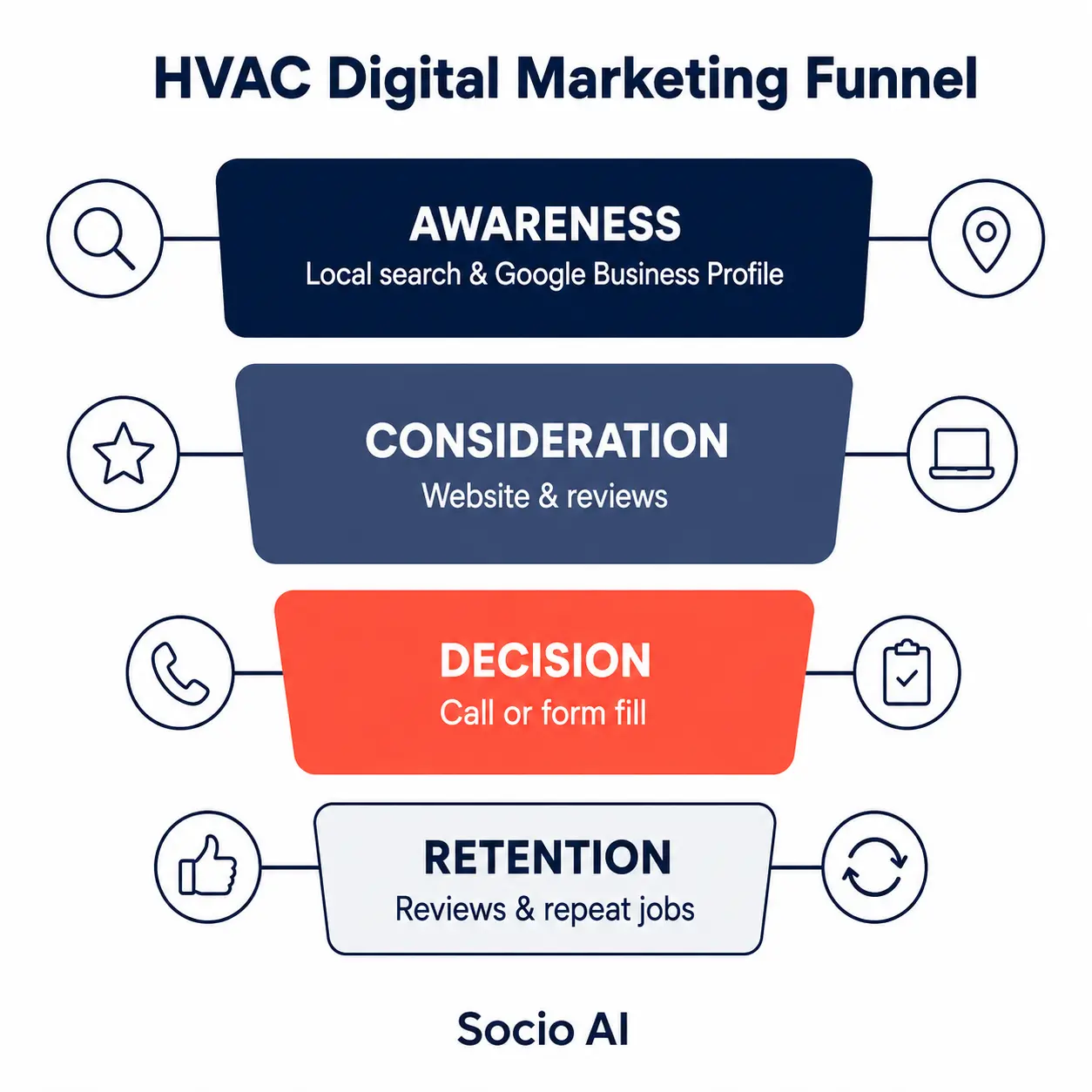
HVAC internet marketing works best when several channels reinforce each other. A homeowner might first see your business in a Google Map result, click through to your website, read reviews, and only then call. If any one of those steps is weak, the lead leaks. Below are the channels that matter most for heating and ventilation companies, and how each one fits into a complete digital marketing system.
Local SEO
Local SEO for your website is the foundation of digital marketing for HVAC companies. It helps your business appear in local Google search results for high-intent terms like “AC repair near me,” “furnace repair [city],” and “HVAC company [neighborhood].” Because HVAC demand is local, urgent, and often mobile, ranking your website on the 1st page of Google Search directly drives leads.
Strong local SEO covers on-page service and city pages, accurate business categories, NAP consistency across directories, and content that signals service-area relevance to Google. It compounds over time and reduces dependence on paid lead platforms.
Learn more about our HVAC SEO services.
Google Business Profile Optimization
Your Google Business Profile (GBP) is often the first thing a homeowner sees when they search for an HVAC company. It controls how you appear in Google Maps, the Search local 3-pack, and brand searches. A complete, well-optimized profile with accurate hours, services, service areas, photos, and active posting can outperform a much larger competitor with a neglected profile.
GBP optimization includes choosing the right primary and secondary categories, listing every service you offer, defining service areas correctly, uploading recent job photos, and posting updates regularly. Combined with consistent review activity, it’s one of the highest-leverage parts of HVAC digital marketing.
Learn more about our HVAC SEO services.
Reviews and Reputation Management
Reviews influence both rankings and conversions for your Google Business Profile and website. Recent positive reviews help homeowners feel confident contacting your business, and review volume and recency are signals Google uses for local prominence. Just as important, responding to reviews, both positive and negative, shows professionalism and improves trust at the moment a homeowner is deciding who to call.
The HVAC companies winning locally are usually the ones with a system: every completed job triggers a review request, every review gets a thoughtful response, and the team monitors review velocity over time.
Learn more about HVAC reviews and reputation management.
A Fast, Conversion-Focused Website
When paired with local SEO, your website receives traffic from potential paying jobs. Traffic without conversion is wasted effort. An HVAC website should load fast, work flawlessly on mobile, surface the phone number on every page, instill trust, and make it obvious what you do and where you serve. Service pages should match how homeowners actually search (“AC repair,” “furnace installation,” “heat pump replacement”), and city pages should cover every market you work in.
For HVAC companies operating in bilingual markets, having Spanish-language pages can also unlock demand competitors miss entirely. A good website also reinforces SEO by giving Google more relevant content to rank.
See our approach to HVAC website design.
Google Search Ads
Paid search ads (PPC) capture urgent demand immediately. When a homeowner has no AC in July or no heat in January, they’re not browsing — they’re ready to call. Google Search Ads (and Local Services Ads, which run on a pay-per-lead model) put you at the top of those high-intent searches before SEO results.
Paid ads work best as part of a complete system: a strong Google Business Profile, a fast site, and good reviews all increase the conversion rate of every paid click. Running ads without those fundamentals usually means paying more per booked job than you should.
Social Media and Paid Social
Social media is rarely the main driver of emergency HVAC leads, but it builds familiarity and trust over time. Posting before-and-after photos, seasonal maintenance reminders, and team content keeps your business visible to homeowners in your service area. Paid social can also support seasonal promotions and tune-up specials. Paid social is the strategy of paying to have your content shown to specific audiences. This can work with seasonal promotions.
For most HVAC companies, social media is a supporting channel rather than a primary one. It reinforces the brand recognition that makes every other channel work better.
Why HVAC Digital Marketing Benefits Companies
A complete HVAC digital marketing system helps companies grow in practical ways:
- Steadier lead flow during slow weeks
- Stronger visibility in Google Maps and local search
- More trust from recent reviews
- Higher conversion rates from website visitors
- Less dependence on referrals and expensive lead platforms
- Clearer reporting on what drives calls and leads
It also compounds over time. Reviews strengthen trust. Better website content supports local SEO rankings. A stronger Google Business Profile increases local search and maps visibility. Together, those assets reinforce each other and make future marketing more effective.
For example, Socio AI focuses on practical growth for home service companies through stronger Google visibility, review automation, local SEO and bilingual website creation. That can help HVAC companies fill the board in slower periods, capture peak-season demand, and better serve both English- and Spanish-speaking households.
What to Look for in HVAC Digital Marketing Services
When comparing HVAC digital marketing services, look for a provider that understands service-area businesses and can execute the full system, not just one piece.
- Local SEO expertise
- Google Business Profile optimization
- Review generation and response support
- High-quality website creation
- Strong conversion focus
- Clear reporting
- Fast launch process
- Experience with home service companies
- English and Spanish strategies
Our HVAC marketing agency aligns with those needs through local SEO, bilingual website creation, Google Business Profile optimization, automated review requests and responses, reporting, and a streamlined setup built for home service businesses — all for $150/month with no setup fee.
Conclusion
HVAC digital marketing helps your company get found when homeowners are ready to act, build trust faster, and turn local searches into booked jobs. The best results come from a unified system of visibility, reputation, and conversion, not disconnected tactics.
If you want a simpler path to more calls, more reviews, more booked jobs, and less marketing complexity, work with our HVAC Marketing Agency.
HVAC Digital Marketing FAQs
What is digital marketing for HVAC?
Digital marketing for HVAC is the system of online channels — local SEO, Google Business Profile, a conversion-focused website, reviews, and paid ads — that helps a heating and cooling company get found by nearby homeowners and turn that visibility into calls and booked jobs. Unlike print or referral-only marketing, it reaches homeowners at the exact moment they’re searching for service.
How much does HVAC digital marketing cost?
HVAC digital marketing pricing varies widely. Most established agencies charge $1,500–$5,000+ per month, with some specialty firms charging $7,500 or more. At the other end, Socio AI offers full-service HVAC digital marketing — website, SEO, GBP optimization, and review automation — for $150/month with no setup fee, making it one of the most affordable options available. For a full breakdown, see our HVAC marketing agency pricing comparison.
What’s the difference between HVAC digital marketing and HVAC SEO?
HVAC SEO is one part of HVAC digital marketing. SEO focuses specifically on ranking your website and Google Business Profile in organic search results. Digital marketing is the broader system that also includes paid ads, reviews, social media, and conversion-focused web design. Most HVAC companies need SEO as the foundation, then layer in the other channels based on their goals and budget.
Does digital marketing work for heating and ventilation companies?
Yes — and arguably more than for most other industries. HVAC demand is highly local, often urgent, and almost always starts with a Google search. That makes channels like local SEO, Google Business Profile, and Google Search Ads especially effective for heating and ventilation companies. Companies that show up in the local pack with strong reviews and a fast website consistently book more jobs than those relying only on referrals.
How long does HVAC internet marketing take to work?
Paid ads can drive leads within days. Google Business Profile optimization and review activity often produce visible results within 2–4 weeks. Local SEO typically takes 2–5 months to show meaningful ranking gains, and 6–12 months to fully compound. The companies that win long-term are the ones that don’t pause when results take time to build.
What’s the best digital marketing channel for HVAC?
For most HVAC companies, the highest-leverage channel is the combination of Google Business Profile optimization plus reviews — it’s free, drives local-pack visibility, and directly influences call volume. Local SEO is the next priority for long-term growth, followed by Google Search Ads for capturing urgent seasonal demand. Social media and paid social are supporting channels.
Do small HVAC companies need digital marketing?
Yes — and small HVAC companies often benefit the most. A small operator with a strong Google Business Profile, recent reviews, and an SEO optimized website can outrank larger competitors in their service area. Digital marketing levels the playing field because Google rewards relevance and reputation, not company size.
Can I do HVAC digital marketing myself?
Yes, especially the basics — claiming and optimizing your Google Business Profile, asking customers for reviews, and keeping your website information accurate. The harder parts are technical SEO, building city and service pages that rank, monitoring competitors, and staying consistent during busy seasons. Most HVAC owners find it works to handle the basics themselves and bring in help for the rest. For a fuller breakdown, see DIY HVAC marketing or hire an agency.